

TMS Therapy vs. Antidepressants: Which Is Right for You?
Comparing TMS therapy and antidepressants for depression treatment. Dr. Jocelyn Kelly Bayliss, MD, explains the differences in effectiveness, side effects, cost, and who may benefit most from each approach at Ivy Collaborative Healthcare in Augusta, GA.
If you or someone you love is living with depression, choosing the right treatment can feel overwhelming. Two of the most widely discussed options today are antidepressant medications and transcranial magnetic stimulation (TMS) therapy. Both are clinically validated, FDA-recognized approaches, but they work in very different ways and may suit different people depending on their history, preferences, and treatment goals.
As a double board-certified psychiatrist at Ivy Collaborative Healthcare in Augusta, GA, I help patients navigate this decision every day. In this article, I will walk you through the key differences between TMS therapy and antidepressants so you can have a more informed conversation with your provider about the path that may work best for you.
What Are Antidepressants and How Do They Work?
Antidepressant medications are the most commonly prescribed treatment for major depressive disorder. They work by altering the balance of neurotransmitters, the chemical messengers in your brain that regulate mood, sleep, appetite, and energy. The most frequently prescribed classes include:
- SSRIs (Selective Serotonin Reuptake Inhibitors) such as sertraline (Zoloft), fluoxetine (Prozac), and escitalopram (Lexapro)
- SNRIs (Serotonin-Norepinephrine Reuptake Inhibitors) such as venlafaxine (Effexor) and duloxetine (Cymbalta)
- Atypical antidepressants such as bupropion (Wellbutrin) and mirtazapine (Remeron)
Antidepressants typically require four to six weeks before patients notice meaningful improvement, and finding the right medication at the right dose often involves a process of trial and adjustment. The landmark STAR*D clinical trial found that only about one-third of patients achieved remission with their first antidepressant, and roughly one-third of all participants did not reach remission even after four sequential medication trials.
What Is TMS Therapy and How Does It Work?
Transcranial magnetic stimulation (TMS) is a non-invasive brain stimulation therapy that uses focused magnetic pulses to stimulate nerve cells in the dorsolateral prefrontal cortex, the region of the brain most closely associated with mood regulation. Unlike medications that travel throughout the entire body, TMS targets the brain directly without entering the bloodstream.
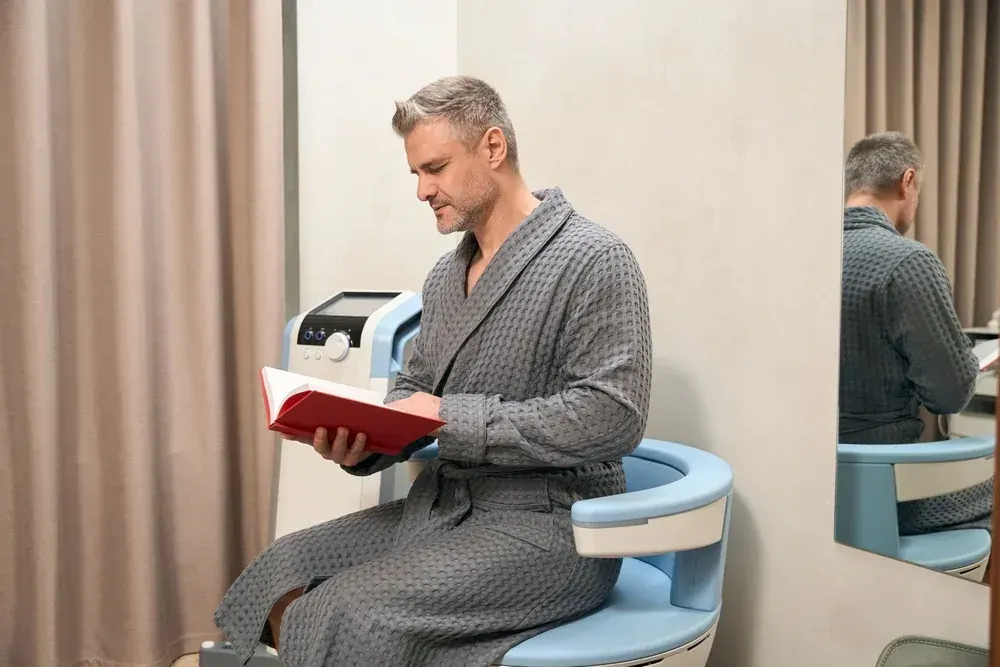
At Ivy Collaborative Healthcare, we use Exomind TMS Therapy, an advanced system that employs patented ExoTMS technology. Exomind uses adaptive stimulation that reads and responds to your unique brain activity in real time, allowing each session to be personalized with precision. Sessions typically last less than 30 minutes, require no anesthesia or sedation, and patients can drive themselves home and return to normal activities immediately afterward.
A standard TMS treatment course consists of approximately 30 to 36 sessions delivered over six to nine weeks. TMS received FDA clearance for major depressive disorder in 2008 and has since been cleared for additional indications including obsessive-compulsive disorder (OCD) and anxious depression.
TMS Therapy vs. Antidepressants: Side-by-Side Comparison
The following table summarizes the key differences between these two treatment approaches to help you evaluate which may align with your needs:
| Factor | Antidepressants | TMS Therapy |
|---|---|---|
| How it works | Adjusts brain chemistry systemically via oral medication | Stimulates targeted brain regions with magnetic pulses |
| FDA cleared | Yes, multiple classes approved for depression | Yes, FDA cleared for MDD, OCD, and anxious depression |
| Remission rate | Approximately 33% with first medication (STAR*D trial) | Approximately 30-37% in clinical studies, including treatment-resistant cases |
| Time to response | 4-6 weeks for initial effects; may require multiple trials | Improvements typically noted within 2-4 weeks of daily sessions |
| Common side effects | Weight gain, sexual dysfunction, nausea, fatigue, insomnia, emotional blunting | Mild scalp discomfort or headache at stimulation site (usually resolves within first week) |
| Systemic side effects | Yes, medication circulates throughout the body | No systemic side effects; stimulation is localized to the brain |
| Drug-free | No | Yes, completely drug-free |
| Treatment duration | Ongoing daily medication, often months to years | 6-9 week course of 30-36 sessions; maintenance sessions may be recommended |
| Session time | N/A (daily pill) | Under 30 minutes per session |
| Downtime | None from taking the pill; side effects may impact daily function | None; return to normal activities immediately |
| Insurance coverage | Widely covered with low copays | Covered by most major insurers after documented medication failure(s) |
| Approximate cost | $10-$50/month with insurance | $6,000-$12,000 total without insurance; copays of $20-$60/session with coverage |
Pros and Cons of Antidepressants
Advantages:
- Widely available and easy to start; any licensed prescriber can initiate treatment
- Low out-of-pocket cost for most insured patients
- Extensive decades-long safety and efficacy research
- Effective for a broad range of mood and anxiety disorders
- Can be combined with therapy and other treatments
Potential drawbacks:
- Side effects such as weight gain, sexual dysfunction, nausea, and fatigue are common and may persist
- Finding the right medication often requires trial and error over several months
- Stopping medication abruptly may cause discontinuation symptoms
- Some patients experience emotional blunting or reduced motivation
- Long-term use raises questions about dependency and withdrawal for some individuals
Pros and Cons of TMS Therapy
Advantages:
- Non-invasive and completely drug-free
- No systemic side effects such as weight gain, sexual dysfunction, or GI discomfort
- Targeted treatment directly stimulates the mood-regulating brain region
- No sedation required; patients remain awake and alert during sessions
- Studies suggest sustained improvement, with research indicating that approximately 66% of responders maintained benefits at one-year follow-up
- May be used as a standalone treatment or alongside medication
Potential drawbacks:
- Requires a time commitment of daily in-office sessions over several weeks
- Higher upfront cost compared to medication, though insurance coverage is expanding
- Mild scalp discomfort or headache during initial sessions (typically transient)
- Not every patient is a candidate; those with certain metallic implants or seizure disorders may need alternative options
- Insurance typically requires documented failure of one or more antidepressant trials before approving coverage
How Does TMS Compare to ECT?
Some patients ask about electroconvulsive therapy (ECT) as another alternative. While ECT remains one of the most effective treatments for severe, treatment-resistant depression, it requires general anesthesia, may cause temporary memory loss, and typically involves a more intensive recovery period. TMS, by contrast, is non-invasive, requires no anesthesia, and carries no risk of memory-related side effects. For many patients with moderate to severe depression who have not responded to medications, TMS may offer a less invasive step before considering ECT.
Who May Be a Good Candidate for TMS?
TMS therapy may be particularly worth considering if you:
- Have tried one or more antidepressant medications without adequate improvement
- Experience side effects from medication that significantly impact your quality of life
- Prefer a drug-free treatment approach
- Are looking for a targeted therapy that does not affect the rest of your body
- Have been diagnosed with major depressive disorder or co-occurring anxiety that has proven resistant to standard treatment
It is important to note that TMS is not an either-or decision. Many patients benefit from a combined approach, using TMS alongside medication management and psychotherapy for comprehensive care. At Ivy Collaborative Healthcare, Dr. Bayliss works with each patient to develop a personalized treatment plan that may include psychiatric medication management, Exomind TMS, or a combination of both.
What Does the Research Say?
The evidence base supporting TMS continues to grow. A meta-analysis published in BMC Psychiatry found that repetitive TMS (rTMS) used as an adjunctive treatment after two antidepressant failures demonstrated a response risk ratio of 2.25 and a remission risk ratio of 2.78 compared to sham stimulation, suggesting meaningful clinical benefit for treatment-resistant patients. The Mayo Clinic notes that TMS is generally considered when other depression treatments have not been effective, and research continues to explore its applications across additional psychiatric conditions.
Meanwhile, antidepressants remain a well-studied first-line treatment for depression. The National Institute of Mental Health (NIH) confirms that medication, psychotherapy, or a combination of both are effective for most people with depression, though individual responses vary.
Understanding TMS Therapy Cost and Insurance
One of the most common questions patients ask is about TMS therapy cost. Without insurance, a full course of TMS treatment typically ranges from $6,000 to $12,000. However, most major insurance carriers, including Medicare, Aetna, Blue Cross Blue Shield, and UnitedHealthcare, now cover TMS therapy for depression when specific criteria are met, usually after documented failure of at least one antidepressant medication.
With insurance coverage, patients typically pay copayments of $20 to $60 per session, making the total out-of-pocket cost for a full treatment course significantly more manageable. Our team at Ivy Collaborative Healthcare can help you verify your insurance benefits and understand your coverage before beginning treatment.
Taking the Next Step in Augusta, GA
Choosing between TMS therapy and antidepressants is a deeply personal decision that depends on your unique medical history, treatment goals, lifestyle, and how your body has responded to previous interventions. There is no single right answer, but there is a right answer for you.
At Ivy Collaborative Healthcare, Dr. Jocelyn Kelly Bayliss, MD, provides comprehensive psychiatric evaluations and collaborates with each patient to determine the most effective treatment pathway. Whether that means starting with medication management, exploring Exomind TMS therapy, or developing a multi-modal plan, our goal is to help you find lasting relief.
If you are ready to explore your options, call us at (706) 364-3461 or visit our office at 2100 Central Avenue, Suite 6, Augusta, GA 30904 to schedule a consultation. We serve patients throughout Augusta, Evans, Martinez, North Augusta, Grovetown, Aiken, and the surrounding communities.
References
- Rush AJ, et al. (2006). Acute and longer-term outcomes in depressed outpatients requiring one or several treatment steps: a STAR*D report. American Journal of Psychiatry, 163(11), 1905-1917. PMID: 17074942
- Carpenter LL, et al. (2012). Transcranial magnetic stimulation (TMS) for major depression: a multisite, naturalistic, observational study of acute treatment outcomes in clinical practice. Depression and Anxiety, 29(7), 587-596. PMID: 22689344
- Perera T, et al. (2016). The Clinical TMS Society consensus review and treatment recommendations for TMS therapy for major depressive disorder. Brain Stimulation, 9(3), 336-346. PMID: 27090022
- Trevizol AP, et al. (2023). Efficacy of repetitive transcranial magnetic stimulation (rTMS) adjunctive therapy for major depressive disorder after two antidepressant treatment failures: meta-analysis of randomized sham-controlled trials. BMC Psychiatry, 23, 545. PMID: 37496017
- Dunner DL, et al. (2014). A multisite, naturalistic, observational study of transcranial magnetic stimulation for patients with pharmacoresistant major depressive disorder: durability of benefit over a 1-year follow-up period. Journal of Clinical Psychiatry, 75(12), 1394-1401. PMID: 25271871